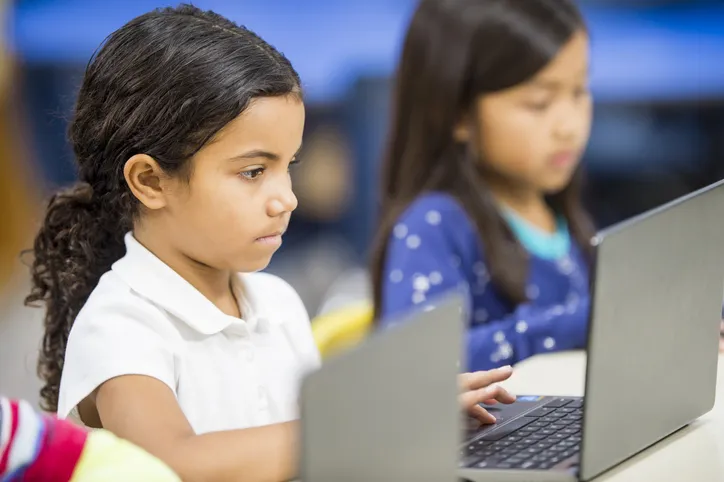
The recent PBS NewsHour story on why Los Angeles USD and other school districts are limiting screen time raises a real concern. Students need discussion, movement, hands-on learning, collaboration, play, and relationships. But screen time is the wrong unit of measurement for meaningful learning. It tells us how long a device was open but nothing about the quality of learning.
A student consuming social media or clicking through low-level test prep worksheets is not equivalent to a student translating text, learning to read with Footsteps2Brilliance, borrowing a book through Libby or Sora, or collaborating on a project. Those all involve a screen, but the learning value is not equivalent.
Treating these as the same in L.A. and other districts is a "L.A.zy" strategy. When schools measure time on a device instead of the task, they miss the point.
Limiting screens can limit reading
The screen time debate ignores that many students now read through school and public library platforms and apps. They listen to audiobooks and read digital books in which they can enlarge type, use built-in dictionaries, annotate, highlight, and translate. They can also borrow far more titles than a school or classroom library could ever stock.
This is mainstream reading. A 2025 Pew Research Center study found that 31% of U.S. adults had read an ebook and 26% had listened to an audiobook. Sora reported nearly 60 million student digital checkouts during the 2024-25 school year, with more than 2.76 million in New York City Public Schools.
Digital reading can also provide privacy. That matters when young people are judged for what they believe, who they are, their reading level, what language they speak, or what they want to understand. It matters even more as books are being challenged and banned. These are often books that help marginalized students see themselves and understand others.
At a time when many students are struggling to read, schools should increase access to high-interest books, not limit ways students find and read them. Paper books should be available, but print is expensive, vulnerable to loss and damage, and limited by shelf space. Digital books do not replace paper, but expand access, choice, privacy, and independence.
Less screen time for whom?
The screen time backlash treats technology as an add-on, or something schools can reduce without consequence. For many students, that is not the case. If it’s not digital, it’s not accessible.
Digital materials can support screen readers, text-to-speech, speech-to-text, enlarged text, captions, adjustable spacing, annotation tools, dictionaries, audio, translation, and more. For many students with disabilities, those tools are not extras, but essential.
But this is not only about students labeled as having special needs. Digital learning can be beneficial for everyone because we all have different needs. Students, like adults, may simply prefer writing and revising on a keyboard. Not because they need an accommodation, but because that is how they prefer to complete their work. That should matter. Choosing to listen instead of read, type or talk instead of handwrite, translate instead of guess, or enlarge instead of strain should not require a label. Technology provides a strategy to address everyone’s learning preferences.
When digital access is treated as something only certain students get, we risk stigmatizing the very students we say we are trying to support. Better design gives all students access to flexible tools and lets students use what works.
Measure learning, not time on screens
Screen time is a weak measure of learning. A better measure is to question what students are doing. Are they consuming or creating? Clicking through drill-and-kill test prep or using tools to investigate, collaborate, translate, revise, read, and create?
That's the point I made in Reverting to Pen And Paper Won’t Improve Learning. Better Learning Design Will. Going back to paper does not automatically make learning deeper, more active, or more human. A worksheet is still a worksheet, whether it is printed or digital.
The same is true in Devices Down Is the Wrong Goal. Sometimes devices should be down. Other times, they should be up. The decision depends on the learning purpose, not the clock.
Models that put student-driven learning into practice don’t measure screen time. These allow students to choose the tools that best help them investigate real questions, create for authentic audiences, and own their learning.
In Dr. Lou Lahana’s multimodal makerspace, students begin with an idea rather than a device. The idea might become a video, art, a coded project, a podcast, a piece of writing, or some combination. The medium follows the purpose, which will eventually be their experience when out working in the real world. That’s what screen-time limits miss.
Teachers need time and support to design active learning with technology. They also need help teaching students to manage distractions and decide when a device is useful. That requires a better model and better professional learning opportunities, not a blanket measurement.
Set the right limits
Schools should limit weak learning activities, not tools. Limit passive consumption, memorization and regurgitation, essays assigned only to prove students did the work, and drill-and-kill test prep. These do not enhance learning whether they happen with support of a device or on paper.
Before restricting screens, schools should ask what students will lose, including access to books, translation, accessibility features, student choice, and opportunities to create. Count the quality of the learning, not the minutes on the device.
