As education budgets tighten and federal relief funding expires, arts programs across the country once again find themselves on the chopping block. Recent federal and state budget proposals reflect a familiar pattern: when policymakers have to make difficult choices, creative subjects are often viewed as supplemental rather than essential. All the while, educators and district leaders continue making the case that the arts support academic achievement, engagement, and whole-child development.
But at a moment defined by rapid AI adoption and ongoing debates about screen time, the argument for protecting and investing in arts education needs to take on a new tone. The arts continue to be one of the most effective places in school for students to build healthier, more intentional relationships with technology.
In short, in the age of AI, we need the arts more than ever.
What Sets Arts Education Apart
While many conversations about classroom technology focus on access, guardrails, or efficiency, arts classrooms offer something different: a model for how digital tools can serve creativity, deepen thinking, and expand opportunity without replacing human judgment. In an era when AI can generate essays, compose music, and create images in seconds, students need structured environments in which technology is used responsibly and reflectively. The arts already provide that structure.
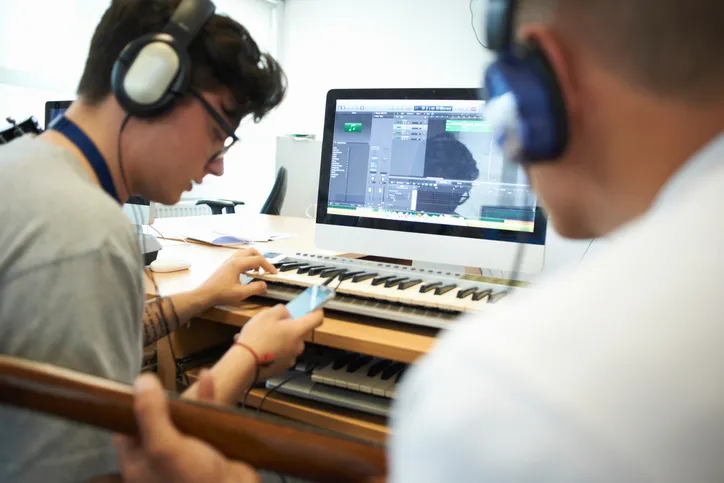
As a district arts coordinator, I have seen this firsthand. A band student of mine who had been uninterested in traditional instruments completely changed when we introduced digital music tools, becoming not only one of the most engaged learners in the class, but also a composer of original music. The introduction of digital tools didn’t replace musicianship — it revealed it. Technology gave this student an accessible entry point into the creative process, and once they had it, their confidence and artistry blossomed.
Digital composition software, notation tools, and recording platforms allow students to experiment, revise, and refine their ideas in ways that would have been far more time-consuming a decade ago. Students can layer tracks, hear immediate playback, annotate their own scores, and collaborate across devices. The same is true in other contexts besides music; in visual arts, for instance, a variety of digital drawing and painting platforms enable students to practice with new mediums, styles, and techniques without having to worry about supplies or messes. But in either case, the core intellectual work of looking and listening critically, understanding structure, and making aesthetic choices remains entirely human and part of the learning.
At every step, technology is embedded within a framework of authorship. Even – and especially – with the help of new tech-enabled tools, students are creators, not just consumers or editors of machine-generated content.
Practically speaking, teachers should encourage students to experiment with tech-enabled arts and music tools. For example, how can each student use the same set of sounds, samples, or colors to create a piece that uses their own unique voice? How can technology be an accelerant for creativity, instead of putting a damper on it?
Tech Also Frees Up Time
Technology in the arts also plays a less visible but equally important role: reducing logistical burdens so teachers can focus on higher-order instruction. Platforms such as MusicFirst streamline assignment distribution, submission, assessment, and feedback with a particular focus on the arts. Instead of collecting paper scores, managing physical recordings, or juggling disparate tools, teachers can handle routine tasks—organizing files, timestamping submissions, tracking revisions—which frees us to spend more time on musical interpretation, technique, and creative problem-solving.
Creating such efficiency also allows for more one-on-one conferencing, more targeted feedback, and more opportunities to guide students through complex artistic decisions. Rather than troubleshooting formatting issues or managing classroom logistics, teachers can ask deeper questions: Why did you choose this harmony? How does this dynamic shift change the emotional arc? What alternatives did you consider?
Cycles of Experimentation
Perhaps most importantly, arts technology creates safe, structured spaces for iteration and failure. In arts software, students can revise endlessly without wasting materials or losing prior drafts — whether that’s tempo and instrumentation in music or color and line in visual art. The experience of creating art enables students to manage pace, embrace iteration, and develop delayed gratification — skills that are increasingly rare in digital environments built around instant results.
The creative process will always require patience and sustained attention. Arts instruction gives students a structured, supportive space to slow down, revisit their thinking, and understand that excellence emerges from cycles of experimentation rather than immediate perfection. That’s an idea that teachers can encourage by dedicating time for students to review their own (or their peers’) work, or to make changes to tempo, color, or tone just to see what happens. They may very well like the result.
Arts Education: Tech At Its Best?
As education leaders navigate AI policies, digital citizenship frameworks, and technology procurement decisions, they should look to arts classrooms as proof of concept. The arts demonstrate what technology integration at its best can look like when it is grounded in human intention, structured creativity, and professional educator guidance.
If we want students to use technology with intention, creativity, and integrity, we must protect the classrooms that already teach all these how. The future of digital citizenship may depend on keeping the arts in our schools.
