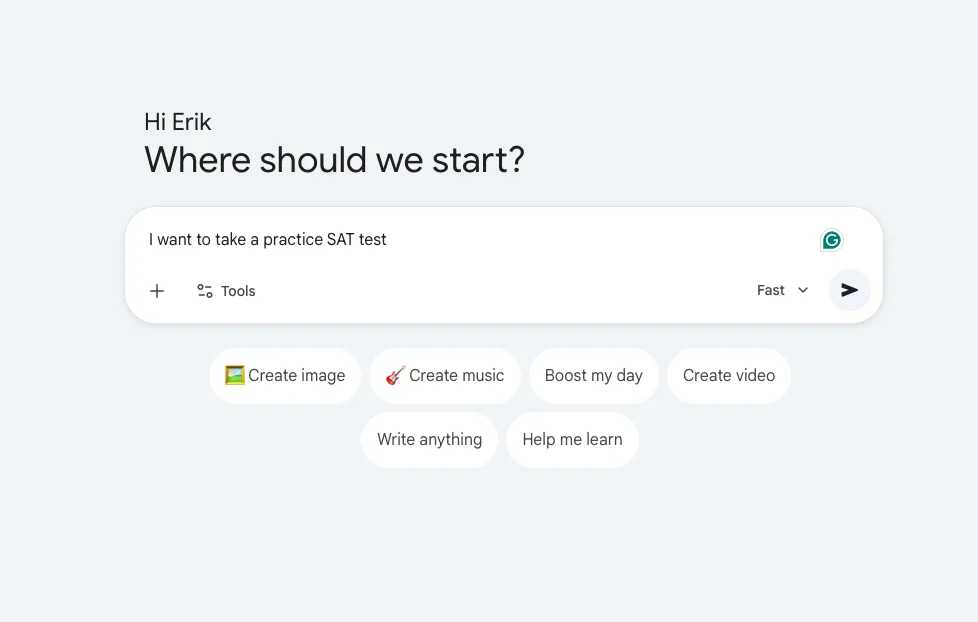
Google is attempting to position Gemini as a leader for AI tutoring when it comes to standardized test prep for the SAT and other tests. Earlier this year, they announced a partnership with the Princeton Review to allow practice tests followed by instant feedback from Gemini that can tell a student where they excelled and highlight areas they might need to study more.
The feature builds on Gemini’s learn mode. Previously called “Guided Learning,” this is a tutoring mode built on a collection of AI models called LearnLM that were specifically designed with teaching in mind and built with principles of education science.
Here’s a closer look at Gemini’s tutoring and test prep abilities.
Using Gemini To Prepare for Tests
For SAT prep, Gemini can generate full practice tests for free. All you need to do is enter a prompt such as, “I want to take a practice SAT test,” and Gemini will generate a test on it. This test will utilize resources from the Princeton Review, a test-prep company that draws on real SAT questions to generate practice tests.
In my experience, this feature works just as advertised. It took me only minutes to generate a quick practice test, and I also had the option of having Gemini create sample SAT questions. It quizzed me and offered encouragement when I got questions right and great explanations when I got questions wrong. This is a tool that seems like it would be helpful for students preparing for this test.
This type of access to high-quality practice tests and tutoring is a great way to increase access to better test preparation methods for people from all economic backgrounds as Gemini is available for free. I also suspect Gemini’s AI coaching could be helpful even for those who get one-on-one tutoring.
Google Wants Gemini To Be A Tutoring Leader
This recent foray into test prep is part of Google’s larger effort to make Gemini the go-to AI for tutoring. So far they seem successful in these efforts to me.
Gemini in learn mode has outperformed other similar tools in certain studies. For instance, researchers compared Google Gemini's and ChatGPT's effectiveness for enhancing the academic writing skills of English learners in two Thai universities. The study found “both tools effectively improved linguistic accuracy and essay structure,” however, “Gemini was found to work better than ChatGPT in multimodal feedback and source integration.”
This tracks with my own experience using both tools. While any AI tool has its limitations and subtle inaccuracies can be a big problem for test prep, Gemini in learn mode is the best AI tutor with which I have interacted. And Gemini continues to improve its tutoring features. In addition to the SAT test, Google recently announced Gemini can provide vetted tests for the Joint Entrance Examination, a standardized engineering entrance exam used in India. It also seems likely Google will expand Gemini’s data set to include other standardized tests going forward.
Overall, I’m once again really impressed with Gemini’s tutoring abilities. My graduate school options were somewhat limited because I was so afraid of taking the GRE that any program that required its completion was ruled out. It’s possible had a tool such as Gemini been available when I was younger, I would have felt differently, though I am very happy with the graduate program in which I ended up attending.
As regular Tech & Learning readers know, I have mixed feelings about AI. But I’m impressed by this feature. Using Gemini to prepare for standardized tests feels as if it could have been a game-changer for me personally and may indeed be a game-changer for many students today.

