
The best tools to teach storytelling can also be some of the most ideal ways to engage students, both creatively and more generally with education. From sparking their imaginations to helping structure a creative toolset, these digital assistants can be powerful in the classroom and beyond.
Giving a student the ability to structure and tell a compelling story can help to empower them in terms of literacy, empathy, and critical thinking.
Students can be given the opportunity to explore historical perspectives, dive into personal narratives, build fictional worlds, and present research in a story form. All of which helps strengthen communication skills while learning at the same time.
This guide aims to lay out some of the best tools to teach storytelling in the class and beyond.
Best tools to teach storytelling
Best to teach storytelling overall
Story Xperiential

Story Xperiential is a structured storytelling platform designed to teach narrative creation from the very start. Developed with input from professional storytellers, it focuses on helping students understand how to write a story and why stories work. Rather than functioning as a simple writing app, it delivers a curriculum-driven approach that breaks storytelling into clear, teachable components.
Students can move through the guided stages from idea development and character creation to plot structure, visual storytelling, drafting, and revision. Teachers can assign projects, monitor progress, and facilitate critique sessions -- essential in developing narrative strength. The emphasis on feedback and editing makes it especially strong for longer term development rather than one-off assignments.
Stand-out features include structured storytelling frameworks, scaffolded learning pathways, and cross-curricular flexibility.
This can be well used as part of a longer storytelling system while building in peer critiques to deepen understanding of structure and character development.
Best for interactive stories

SceneCraft
SceneCraft is an AI-powered storytelling tool that allows educators to create interactive, branching narratives through which students make decisions that shape outcomes. This is designed for classroom use by blending writing with decision-based learning, making it ideal for exploring cause and effect, character motivation, and ethical dilemmas.
Teachers can build or edit scenarios while students navigate storylines by selecting different paths. The interactive format often increases engagement, particularly for students who respond well to game-like experiences.
Standout features include AI-assisted scenario generation, branching pathways, and opportunities for social-emotional learning discussions.
Educators can pair digital storytelling with pre-writing story maps -- plus post-activity discussions -- to analyze how different narrative choices alter outcomes.
Best for visual inspiration
Storybird
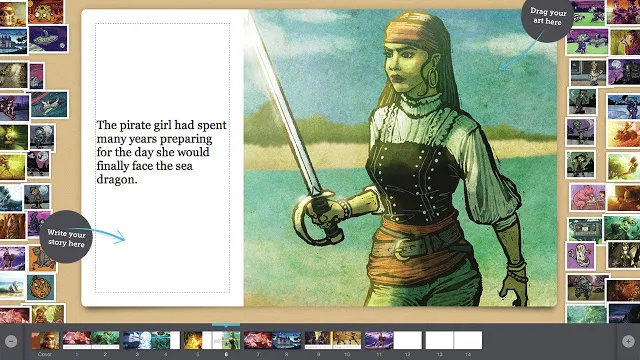
Storybird is a visual storytelling platform that combines student writing with curated professional artwork. Students select images and build stories or poems around these, using visuals as prompts to inspire story ideas. This makes it effective for younger learners and reluctant writers, who can benefit from visual scaffolding.
The interface uses a book-style layout, encouraging students to construct stories page by page. This format reinforces pacing, sequencing, and concise writing.
Teachers can create assignments, review student drafts, and provide feedback directly within the platform.
Strong artwork libraries, support for both poetry and short fiction, and accessible publishing tools are key features.
Teachers can find it effective to use artwork for character development exercises or to set word limits per page to strengthen clarity and narrative precision.
Best for collaborative storytelling

BoomWriter
BoomWriter turns storytelling into a collaborative classroom experience. Students contribute chapters to a shared story, and classmates vote anonymously on submissions to determine which version becomes part of the final narrative. The completed work can then be published as a professionally printed book.
Teachers begin by setting a prompt and writing the opening chapter. Students submit their versions of the next installment, and peer voting selects the continuation. This structured cycle repeats until the story is complete, reinforcing narrative continuity, audience awareness, and revision skills.
The anonymous voting system promotes thoughtful critique while maintaining engagement.
Teachers can use this to establish clear evaluation criteria focused on storytelling craft rather than popularity. This can lead to discussions about why certain chapters effectively advanced the narrative and others did not.
Best for gamification

Imagine Forest
Imagine Forest combines creative writing tools with gamified elements to encourage ongoing storytelling skills. Students can respond to prompts, draft original stories, and publish their work. Badges and achievements help motivate consistent participation.
The structured editor supports story creation while offering built-in prompts to spark ideas. This makes it very useful for daily warm-ups, creative writing clubs, or independent literacy work. Students can develop stories over time, building confidence and fluency.
Pair prompt-based writing with mini-lessons focused on dialogue, pacing, or descriptive language. Also, encourage revision before publication to reinforce storytelling basics.
